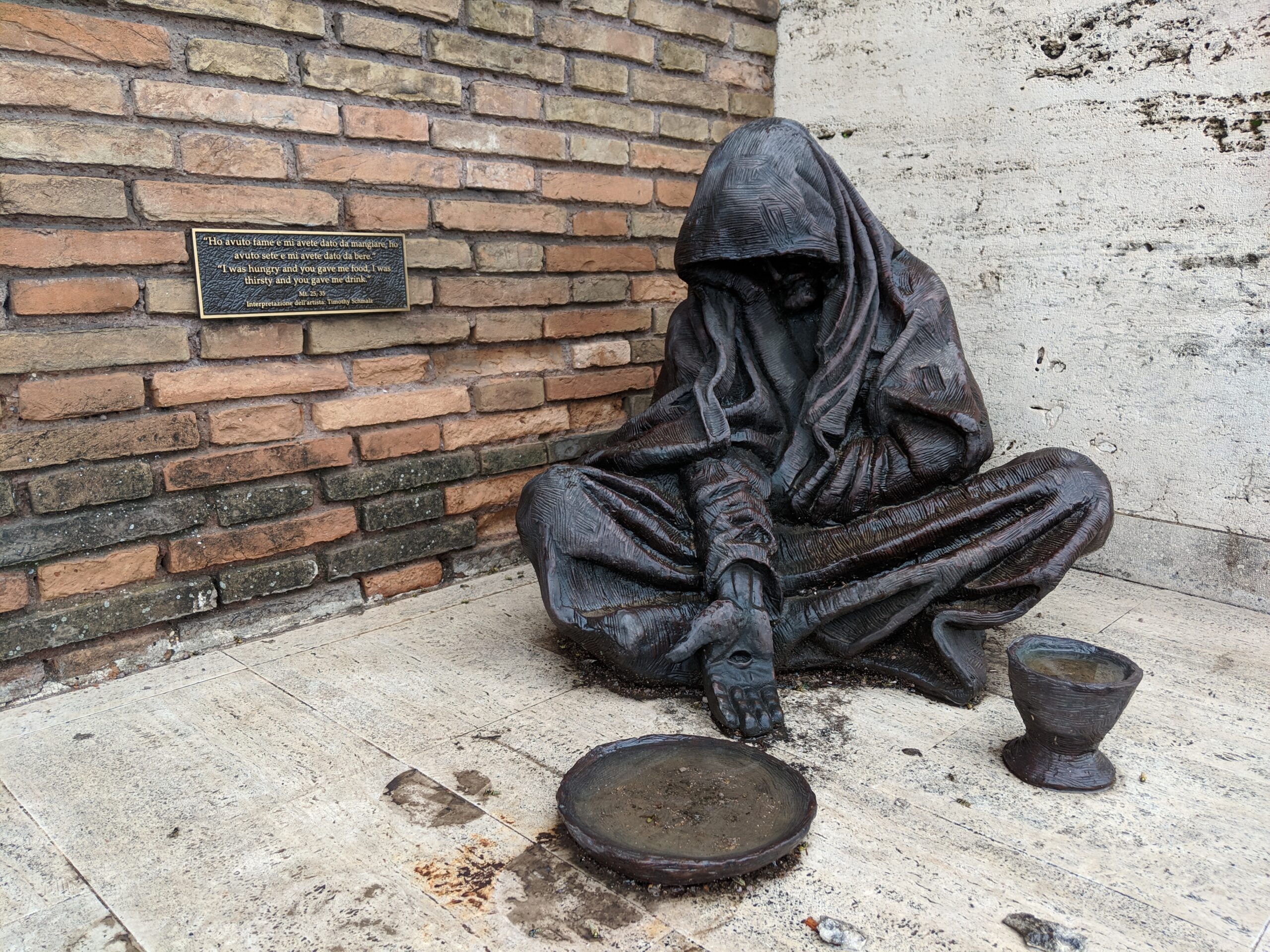

In the Catholic faith, we are called to care for the poor and to work to alleviate poverty. We are also called to be aware of the causes of poverty and to work to change them. Scripture reminds us that we can be financially poor but we can also be poor in spirit and that as followers of Jesus we should show mercy to all people, especially those most in need.
We invite everyone in our school community to lead parts of our prayer throughout the week and staff are encouraged to award achievements points for this!
Day 1 – Head
On the first day of our prayer we will be reflecting on The Word of God to help us to understand our theme.
We begin our prayer this morning with the Sign of the Cross. In the name of the Father, and of the Son, and of the Holy Spirit, Amen.
Today we turn to the Hebrew Scriptures for inspiration on our Word of the Week. This definition may help you to better understand the scripture:
“Sojourner” – This Hebrew term and its translation convey the basic idea that a person (or group) is residing, either temporarily or permanently, in a community and place that is not primarily their own and is dependent on the “good-will” of that community for their continued existence.
A reading from the book of Leviticus
35 “If your brother becomes poor and cannot maintain himself with you, you shall support him as though he were a stranger and a sojourner, and he shall live with you. 36 Take no interest from him or profit, but fear your God, that your brother may live beside you. 37 You shall not lend him your money at interest, nor give him your food for profit. 38 I am the Lord your God, who brought you out of the land of Egypt to give you the land of Canaan, and to be your God.
39 “If your brother becomes poor beside you and sells himself to you, you shall not make him serve as a slave: 40 he shall be with you as a hired servant and as a sojourner. He shall serve with you until the year of the jubilee. 41 Then he shall go out from you, he and his children with him, and go back to his own clan and return to the possession of his fathers.
The Word of the Lord
Thanks be to God
Leviticus 25: 35-42 ESVUK
The Book of Leviticus is the 3rd book in the Bible. After the people of Israel are given The 10 Commandments in the Book of Exodus, the Book of Leviticus is all about the rules that they should follow in order to keep those commandments and to obey God.
Poverty – the condition of being extremely poor.
What rules and policies do we have in the UK that protect or help those in poverty?
What more could be done to respect the dignity of all people, especially those in poverty?
In the name of the Father, and of the Son, and of the Holy Spirit, Amen.
Day 2 – Heart
On the second day of the week we focus on our hearts. How can the scripture that we looked at yesterday impact our lives, and the lives of others? What themes can we draw from the scripture?
We begin our prayer with the Sign of the Cross. In the name of the Father, and of the Son, and of the Holy Spirit, Amen.
The Book of Leviticus offered the people of Israel guidance and instructions on how to live in a way that would please God.
Today, as followers of Christ we are guided by the scriptures and our Catholic Social Teaching.
Catholic Social Teaching (CST) brings together scripture and the teachings of the Church to help us to understand how we should live and how to make decisions in society.
This video from CAFOD helps us to understand what Catholic Social Teaching is:
Scroll back up the page to this week’s scripture and see how many Catholic Social Teaching principles link to this week’s Bible passage. Let us know the links that you made in the comments box below.
Human Dignity – Everyone is special and made in the image and likeness of God.
The Common Good – What is best for everyone?
Subsidiarity – People nearest to the decision should have a say.
Solidarity – We are one with our brothers and sisters and we stand with them.
Preferential option for the poor – We prioritise those in the most need e.g. those in poverty.
Stewardship – We need to care for God’s creation.
The dignity of work and participation – We all want to work and to contribute to our communities.
We end our prayer with the Sign of the Cross. In the name of the Father, and of the Son, and of the Holy Spirit. Amen
Day 3 – Hands
On the final day of the week we try to put into action the things we have learnt and reflected on previously in the week, hence the hands link!
We begin our prayer with the Sign of the Cross. In the name of the Father, and of the Son, and of the Holy Spirit, Amen.
As we saw in our previous prayer resource – a preferential option for the poor is part of our Catholic Social Teaching. This means that, as followers of Christ, we should always prioritise those who are in poverty.
We are about to head into two weeks of half term holidays! It’s a great opportunity to take time for ourselves after a busy half term and to hopefully enjoy some time with friends and family.
Over the next two weeks we are challenging you to put our Catholic Social Teaching into action and to prioritise tackling poverty this half term!
It is totally up to you how you choose to do this, you could:
- donate money to charity
- make a donation to a food bank or homeless shelter
- consider adding your name to outline your opposition to the two-child policy on Universal Credit payments for vulnerable, larger families https://www.cbcew.org.uk/contact-mp-two-child-cap/
- consider answering Cardinal Vincent Nichols’ call on Catholics to take action to oppose assisted suicide https://www.cbcew.org.uk/cardinal-calls-on-catholics-to-take-action-to-oppose-assisted-suicide/
- visit a community café in your area/ at your parish and talk to someone who may be lonely
There are so many ways that you can live out our faith to make a difference to people who face poverty and we are looking forward to hearing how you got on after half term!
During this month of the Holy Rosary we ask Mary to join her prayers with ours as we say,
Hail, Mary, full of grace,
the Lord is with thee.
Blessed art thou amongst women
and blessed is the fruit of thy womb, Jesus.
Holy Mary, Mother of God,
pray for us sinners,
now and at the hour of our death.
Amen.
We end our prayer with the Sign of the Cross. In the name of the Father, and of the Son, and of the Holy Spirit, Amen.





We have thought of ideas on how we should donate to the poor. We can join foodbanks, donate to Charity and give someone a pound outside a shop.
What rules and policies do we have in the UK that protect or help those in poverty?
Can’t discriminate against disadvantaged people
Benefits
Can’t steal
Tax exemption for charities
Free healthcare
Shelters
Food banks
Free school meals
Free education
Human dignity – not making your brother a slave
We discussed how our country supports those who are financially poor. We thought about:
– Universal credit – payments or benefits to support those living in poverty
– Charities – reselling items or clothing at a reduced price to support people living in poverty (e.g. salvation army)
– Food banks – people living in poverty or struggling to afford a decent meal are able to collect food items free of charge from food banks. Items are donated.
We also discussed how many of these are not policies or law in the UK, but the result of people helping each other. We think that more can be done in policy and law to help those in need.